E-E-A-T: Why Google Now Rewards Trusted Brands — And How to Become One
Google doesn't just rank websites any more. It ranks credibility.
If you're a business owner or service provider trying to understand why some competitors consistently outrank you — despite what looks like a similar or even inferior website — this might be the article that changes how you think about search.
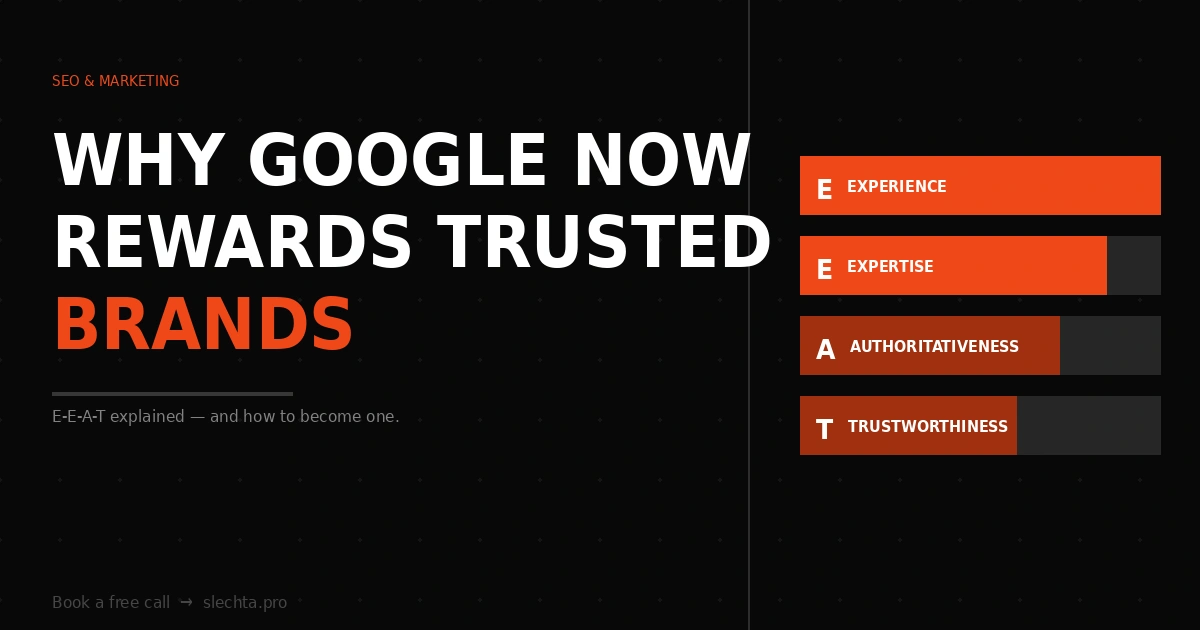
E-E-A-T stands for Experience, Expertise, Authoritativeness, and Trustworthiness. It's the framework Google uses to evaluate whether a website and the people behind it are genuinely qualified to be producing the content they publish. In 2026, it's not a nice-to-have signal — it's a core ranking factor, and it's reshaping which businesses win in search.
What Each Letter Actually Means
• Experience: Has the person writing this actually done the thing they're describing? First-hand experience — case studies, real projects, genuine opinions — signals credibility.
• Expertise: Is this person or business genuinely knowledgeable in their field? Demonstrated through depth of content, credentials, and consistent publishing.
• Authoritativeness: Do other trusted sources recognise this business? Press mentions, industry citations, third-party reviews all contribute.
• Trustworthiness: Is the website secure, transparent, and accurate? Clear contact information, privacy policies, honest content, and a real team behind the site all matter.
When I look at which websites are winning in AI Overviews and standard search rankings right now, the pattern is consistent: they tick multiple E-E-A-T boxes. They have a clear human expert behind the content, they're cited externally, and their website communicates trust at every touchpoint.
Why This Matters More Now Than Ever
The March 2026 Google spam update targeted all languages and locations — another signal that Google is doubling down on quality and authenticity. Combined with AI Overviews that cite specific, trusted sources rather than listing dozens of results, the window for low-quality content to rank is closing.
For small businesses, this is actually good news. You have something that large corporate content farms don't: genuine first-hand experience. A local web designer who has built 50 websites for small businesses in Hertfordshire has more authentic E-E-A-T in that specific niche than a content agency churning out generic SEO articles.
The challenge is making that expertise visible — on your website, in your content, and across the wider web.
How to Build E-E-A-T for Your Business
• Write from experience. Share what you've actually done — real projects, real results, real client situations. This is more valuable than any SEO tactic.
• Show the person behind the business. A real 'About' page with a genuine photo, background, and point of view builds trust faster than any badge or certification.
• Gather and display social proof. Google Reviews, testimonials, case studies — these are external validators that tell both Google and potential clients you're the real deal.
• Get mentioned elsewhere. Contribute to industry publications, be quoted in articles, appear on podcasts. Every credible third-party mention adds to your authority score.
• Keep your information consistent and accurate. Check that your contact details, business name, and services are identical across your website, Google Business Profile, and all directories.
The Website as Trust Signal
Your website is often the final destination after all these trust-building efforts. A potential client reads about you somewhere, finds a mention of your work, sees a review — and then lands on your website. If the website doesn't match the trust they've already started to build, you've lost them.
In my work, I design and build websites that are specifically engineered to communicate trust: clear service descriptions, real case studies, genuine testimonials, fast load speeds, and a design that reflects the quality of the work behind it. E-E-A-T isn't just an SEO framework — it's good business design.